
Jean Phil gets millions of views doing things most of us would be embarrassed to do in a parking lot.
Some people call this AI slop. Sometimes, they’re right. But a lot of these characters are seriously entertaining. You can roll your eyes and still watch the next three videos.
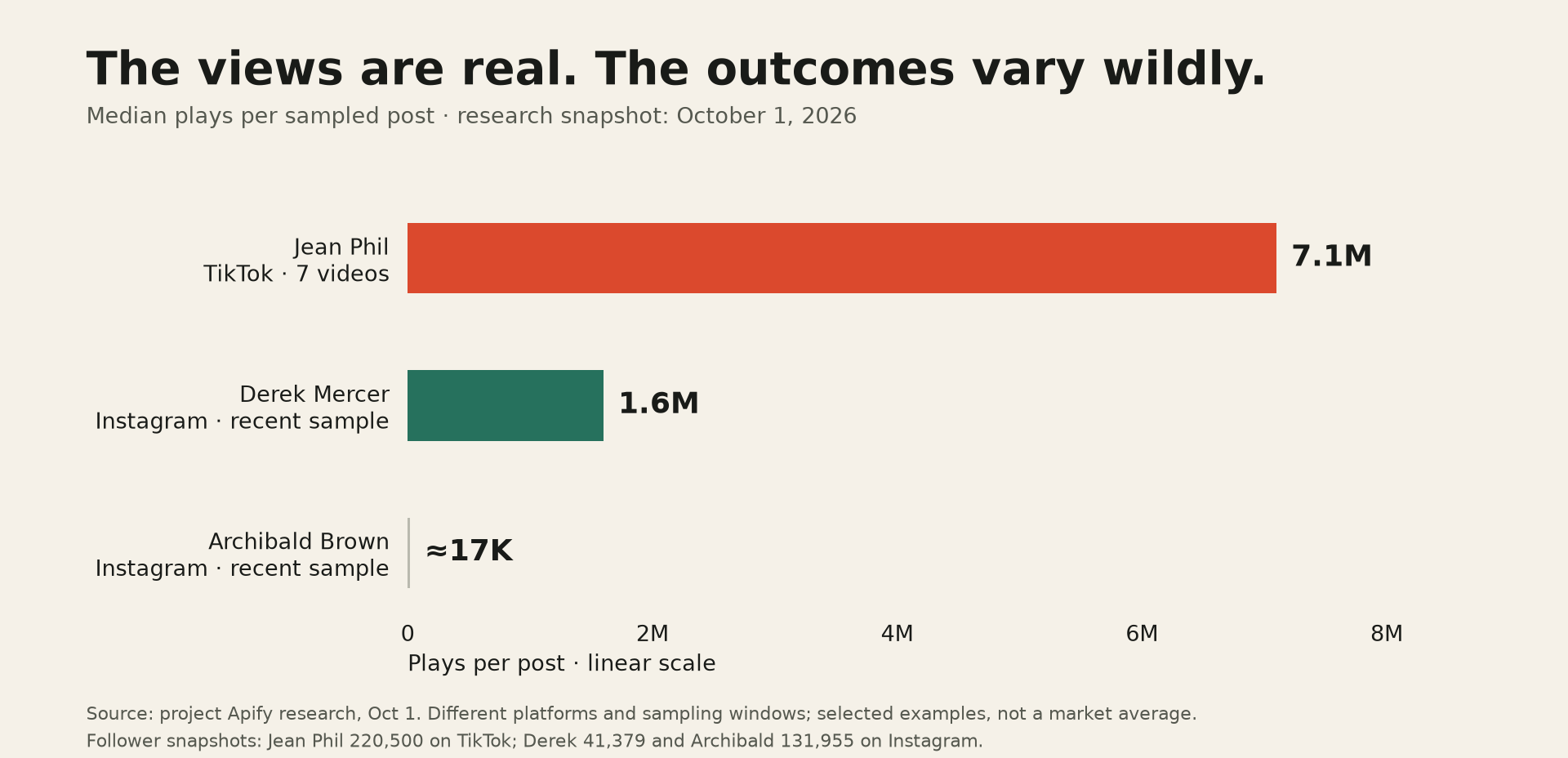
In our October 1 research, his seven sampled TikToks had a median of 7.1 million plays. The biggest hit 14.6 million. His account had 220,500 followers.
Naturally, you think: “I could make one of these.”
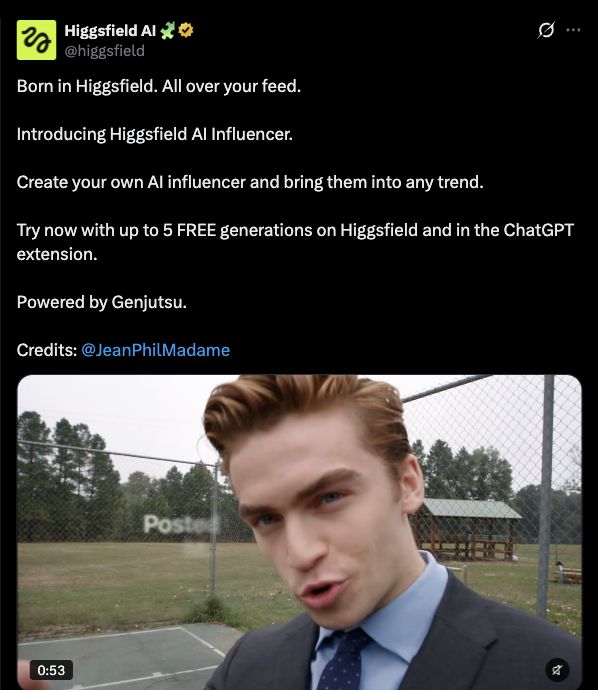
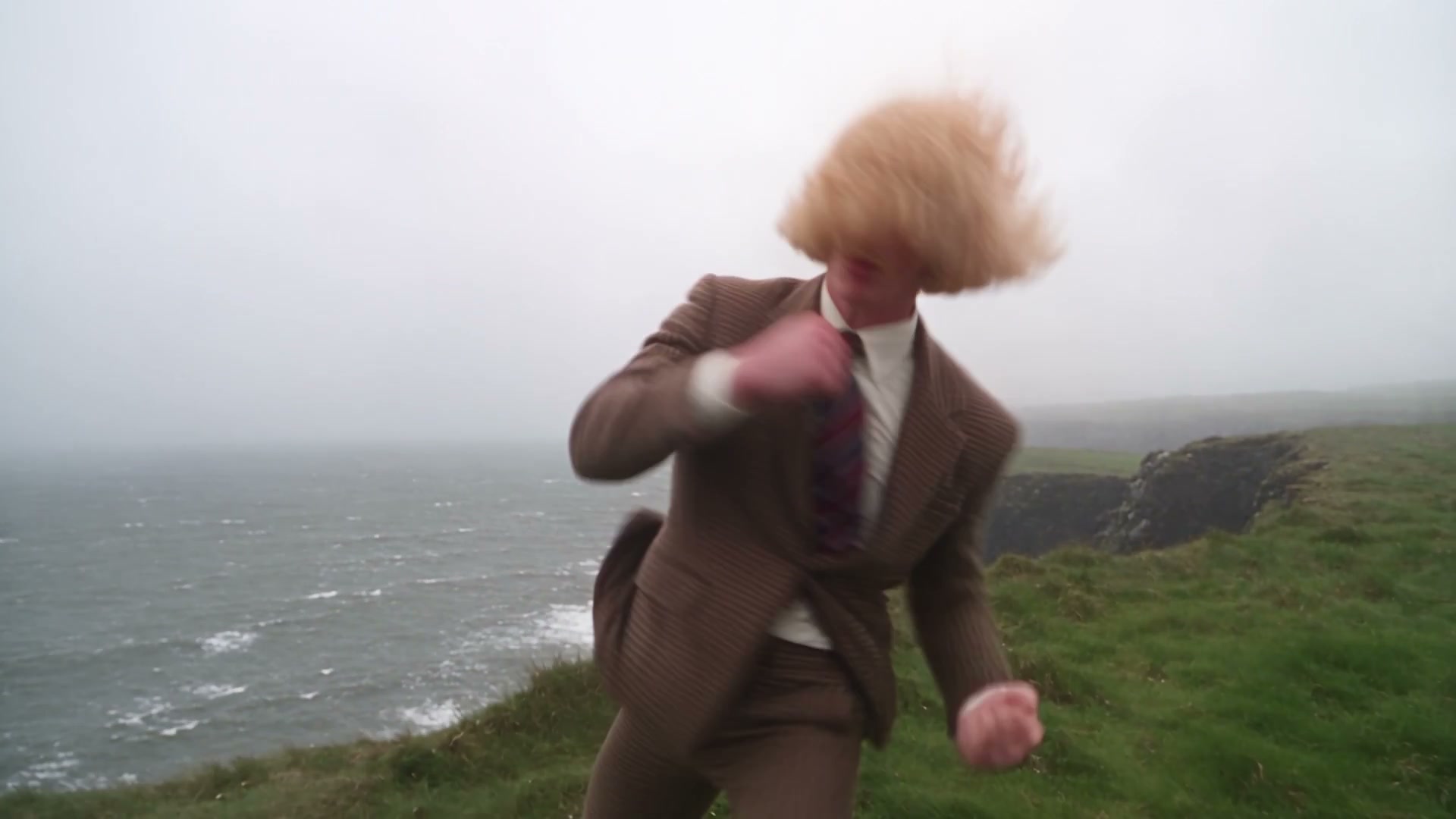
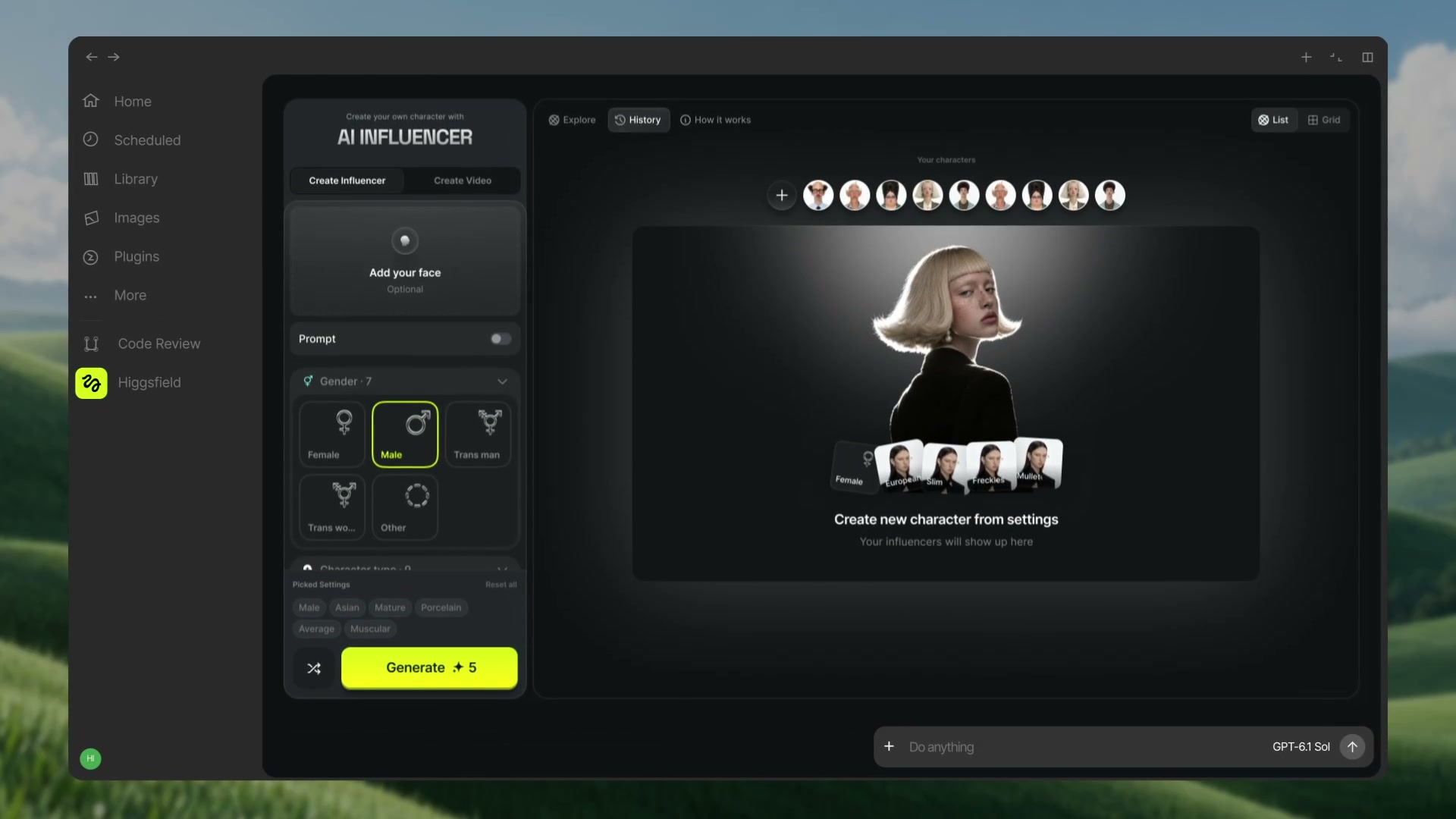
Higgsfield knows. Its own advertisement features Jean Phil and invites you to create an AI influencer. The October 2 X post had 3.3 million views when I checked it on October 11.
Then you open the pricing page. Credits. Tiers. Annual discounts. “Unlimited,” with conditions.
You wanted a dancing man. You got homework.
I've been testing these services for our own AI characters. This is the guide I wanted: what looks good, what the plans actually buy, and where cheap gets annoying.
01 / First, can you actually make this stuff?
Yes. Getting millions of views is a separate question.
Our research also found Derek Mercer getting a median of about 1.6 million views on sampled Instagram posts. Archibald Brown had more followers, but a recent-post median around 17,000 views.
A big audience helps. It does not give every upload a rocket engine.
My money is on Seedance.
For realistic people who follow complicated instructions, Seedance is my pick from our tests.
Higgsfield calls the tool in its ad Genjutsu. My working assumption is that Seedance is involved underneath. Higgsfield has not confirmed that, so treat it as our hypothesis.
Here is why I suspect it. We gave Seedance 2.5 a much harder job than “make a funny man dance.” We asked it to replace specific people with our characters and keep the scene working.
First: replace both boxers. Luc Beau becomes one. Jean Phil becomes the other.
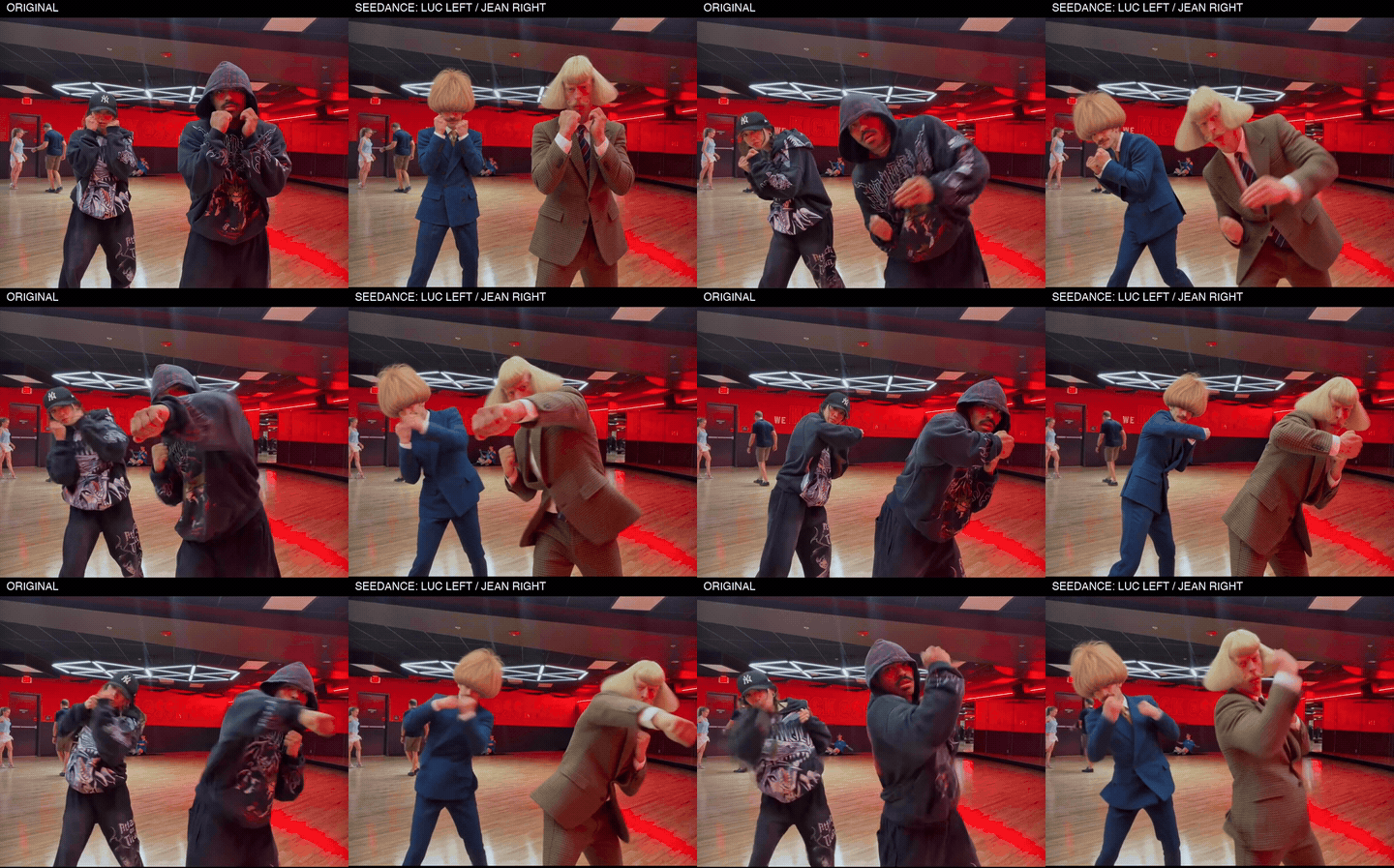
The characters stay in their assigned places. The gym stays recognizable. The punches and dips carry through.
Next: change two people. Leave the third guy alone.
Luc goes in front. Archibald goes in the middle. Jean stays at the back.
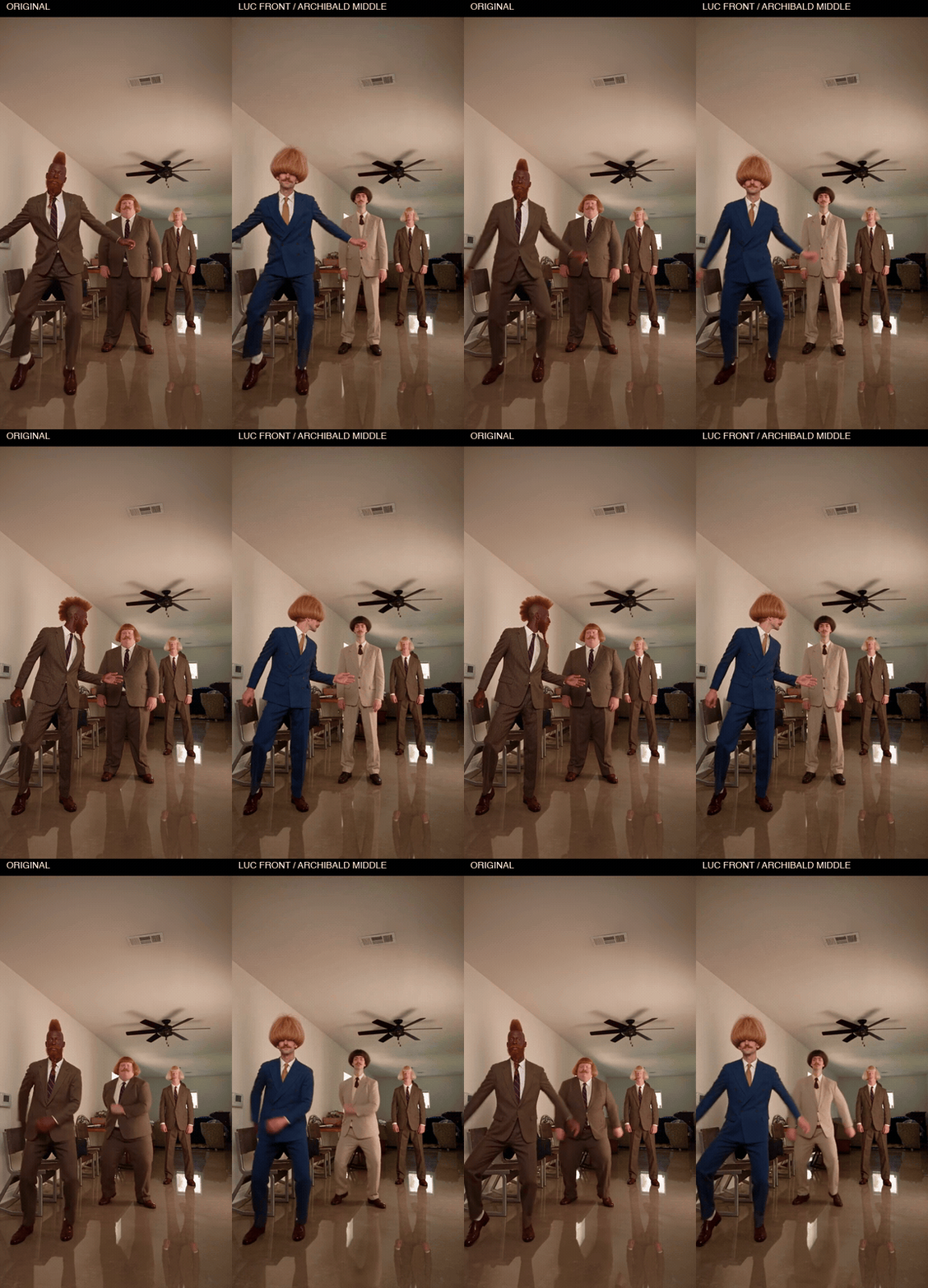
That combination matters: look real, follow directions, keep the right face on the right person.
It is not perfect. Some movements change and small details soften. Wan has also produced a Luc clip we approved, after corrections. But for this kind of character replacement, Seedance is the one I would start with. Test notes.
A remake still needs a rights check. These excerpts are here to discuss the tests; changing the characters does not automatically clear the original footage for reuse. Reuse notes.
02 / Higgsfield: how much video does your plan buy?
Higgsfield puts several video models in one place. You get a friendly interface and less setup. That convenience is worth something.
But a credit is not a second. Your model and resolution decide how far the credits go.
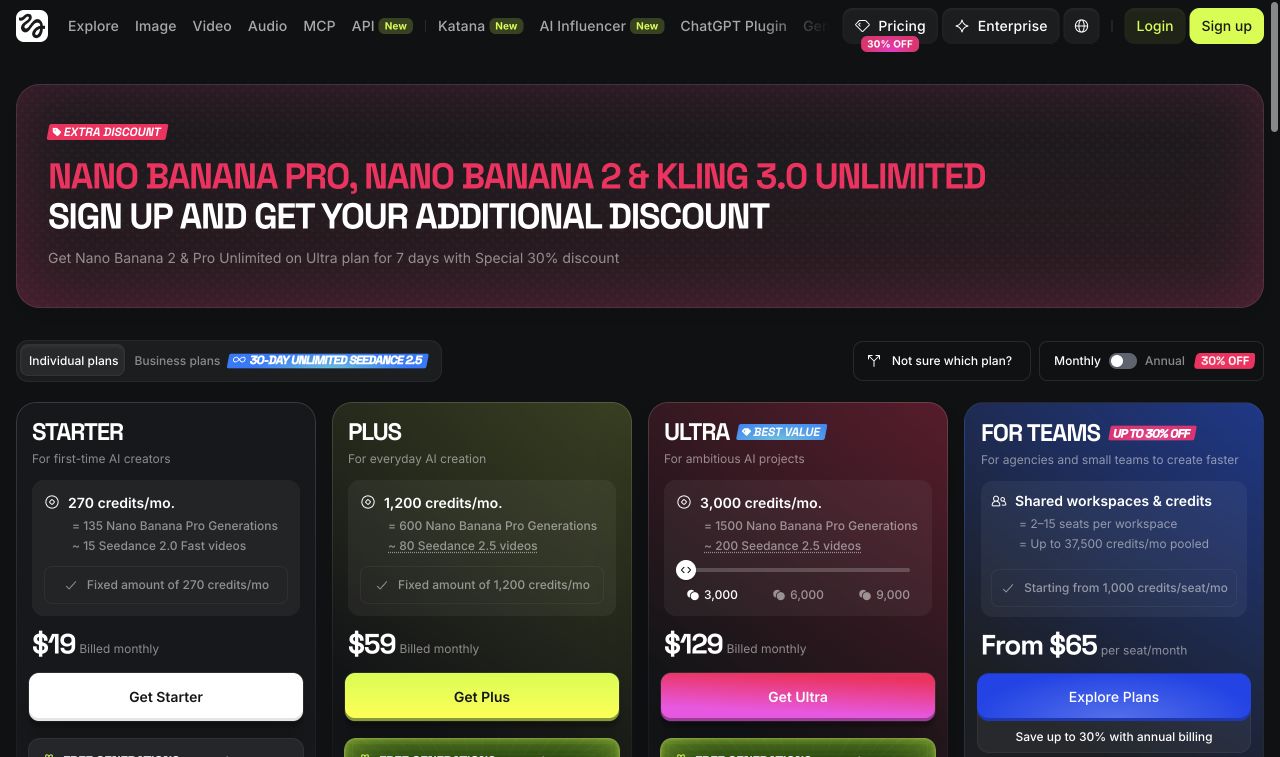
For Seedance 2.5, the quotes I checked were:
- 480p: 30 credits for 10 seconds. Lower resolution.
- 1080p: 120 credits for 10 seconds. Higher resolution, four times the credits.
Here is what each plan's monthly credits buy:
| Plan | Monthly price | Seedance at 480p | Seedance at 1080p |
|---|---|---|---|
| Starter | $19 | Not included | Not included |
| Plus | $59 | 6m 40s | 1m 40s |
| Ultra 3k | $129 | 16m 40s | 4m 10s |
| Ultra 6k | $220 first month, then $250 | 33m 20s | 8m 20s |
| Ultra 9k | $310 first month, then $375 | 50m | 12m 30s |
On Plus, $59 buys 100 seconds of Seedance at 1080p. Before you reject a single take. Your blockbuster has barely found its shoes.
These totals assume you spend every credit on that model. The quotes used no uploaded reference media; a job using a reference clip may have different pricing. Unlimited offers are separate.
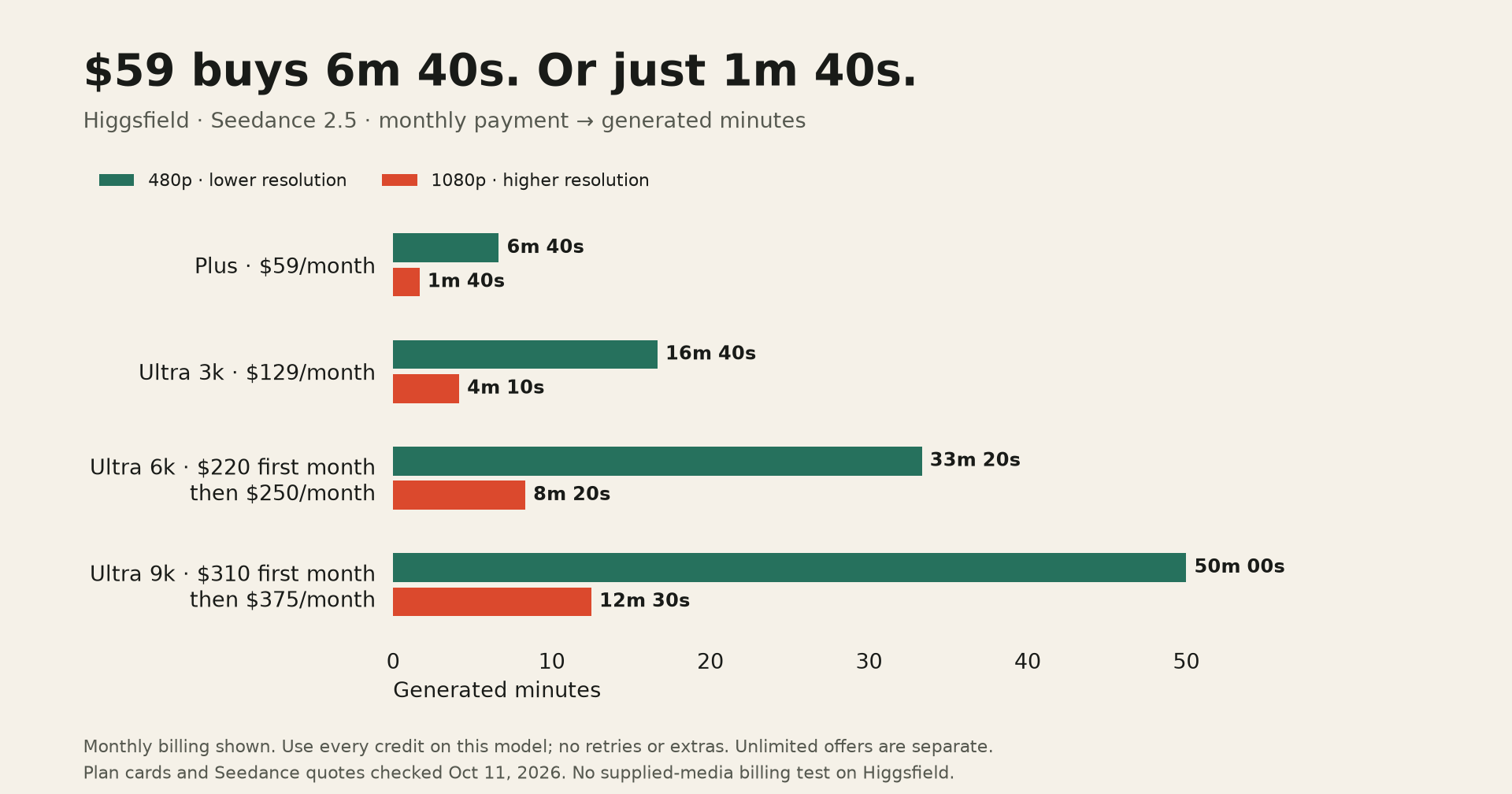
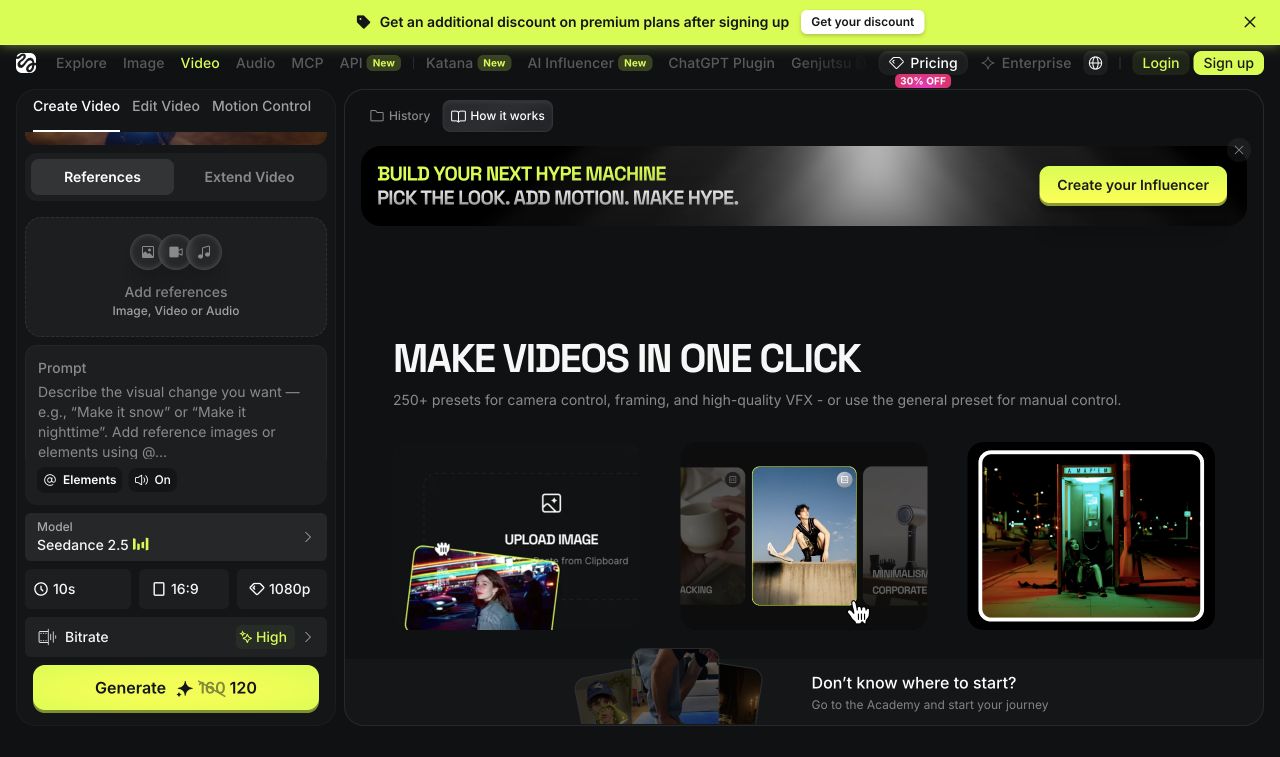
Higgsfield's “~80 Seedance videos” label means five-second videos at 480p. That is 6 minutes and 40 seconds. The number sounds different when you put a clock on it.
Annual billing lowers the monthly equivalent, but you pay the year upfront. Plus, for example, becomes $47 a month, paid as $564. The video allowance stays the same. All annual prices and renewal terms.
And “unlimited”?
Some offers let you generate without using credits, but only for eligible models, resolutions and periods. The site advertises Seedance offers with a 30-day window.
Check that the offer covers what you want to make. The table above counts credits only; it does not include those extra benefits.
If you use code to generate videos, check again. A website offer does not automatically cover automated tools or the separately billed developer API.
Choose the model before the plan.
Wan and Kling use different amounts of credit. The same Plus plan can buy very different lengths of video.
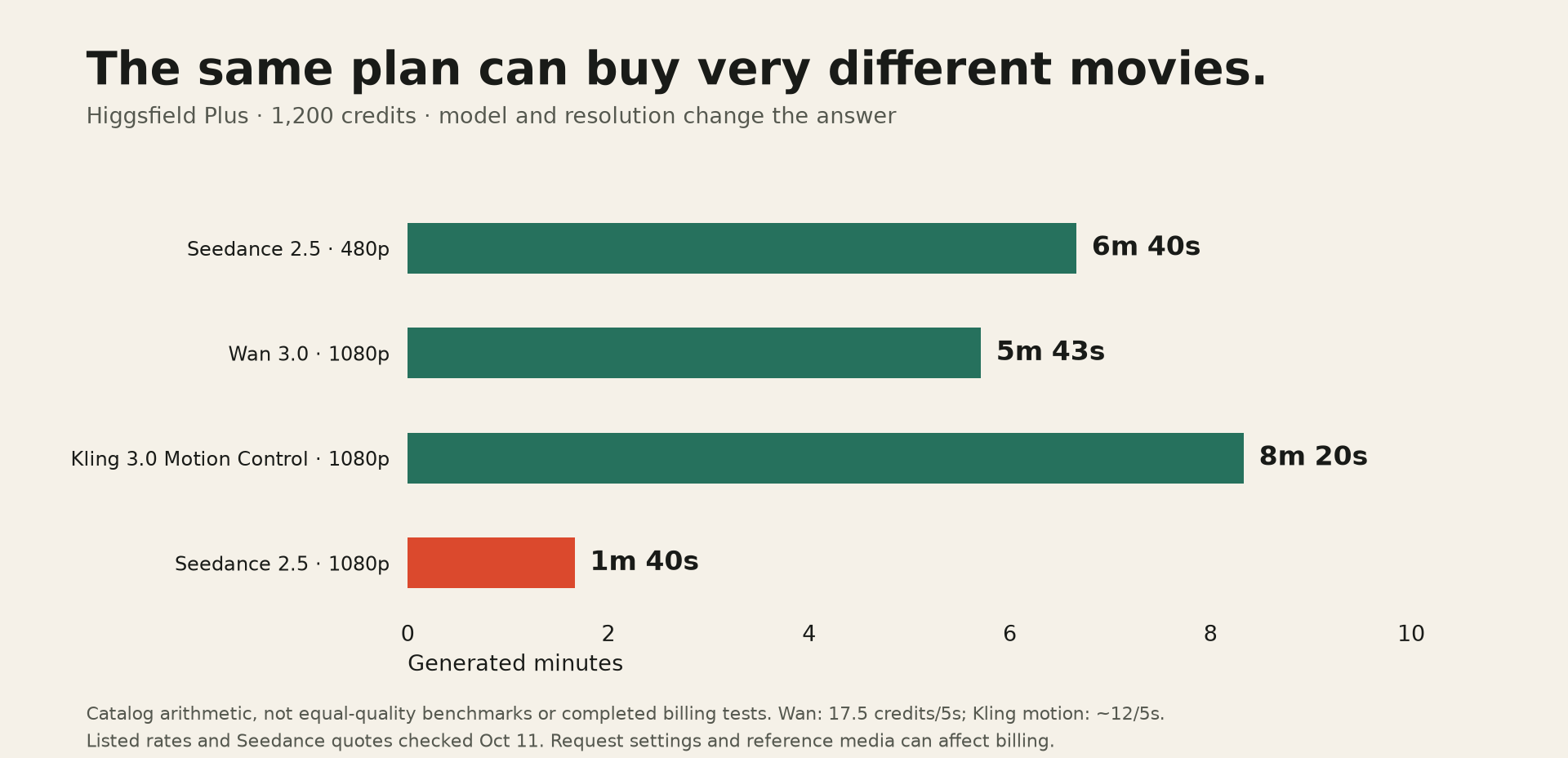
Higgsfield is the convenient option. Whether it is good value depends on which model you use.
03 / Copying a dance can change the bill.
A talking character and a character copying a dance may be priced differently.
Some services charge for the reference video you upload and the video they create.
Take EvoLink's Seedance 2.5 pricing. At 480p, a 20-second reference turned into a 20-second result counts as 40 billable seconds. At its listed rate, that is $3.36. The same example at native 1080p is $18.
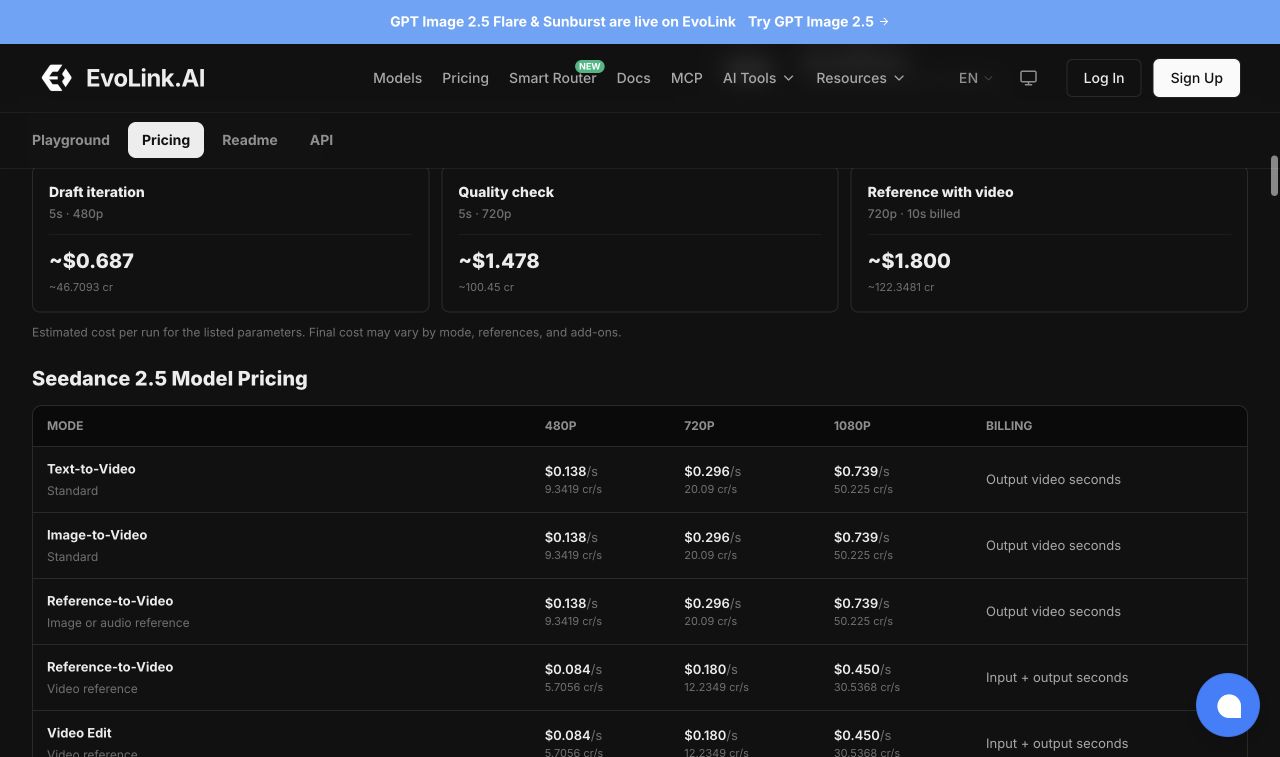
The lesson: a lower “per second” price does not always mean a smaller bill. Ask which seconds you are paying for.
The next comparison uses generation without a reference video. It is closer to our talking-character work.
What about Genjutsu? Is that cheaper?
A little cheaper than one comparable Seedance route, while its API discount lasts.
Genjutsu charges for the length of the video you upload. Its developer API advertises 50% off. Applying that discount gives:
| Resolution | Genjutsu per minute, with 50% off | Before discount |
|---|---|---|
| 480p | $9.54 | $19.08 |
| 720p | $20.43 | $40.86 |
| 1080p | $48.96 | $97.92 |
These are minute-equivalents across shorter clips, not a single 60-second upload. Input length rounds up to whole seconds. Confirm your account's discount before paying. Official rates · Advertised discount.
For equal-length input and output, EvoLink's Seedance reference-video pricing works out to $10.08 per minute at 480p and $54 at 1080p. Discounted Genjutsu is about 5% and 9% cheaper, respectively. We have not tested whether it gives an equally good result.
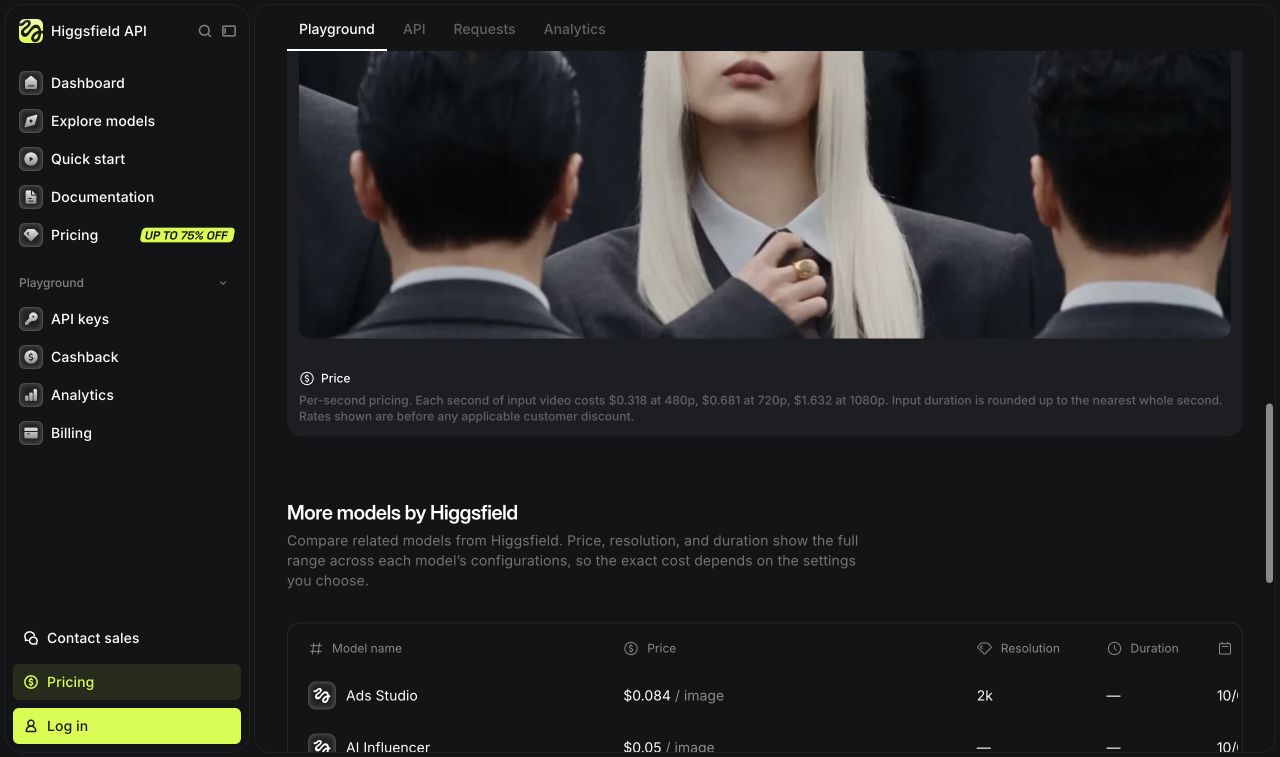
The website subscription is a different bill. It uses credits and shows the cost after you set up a job. The public page also advertises three free 720p Genjutsu generations on the displayed Plus and Ultra plans. I could not verify a website credit quote without supplying a video, so I am not turning those API dollars into subscription minutes. Website details.
04 / Go back to the source. Bring a calculator.
Seedance comes from ByteDance. Wan comes from Alibaba. The French haircut has taken us on a very Chinese software-shopping trip. ByteDance · Alibaba.
That search led us to LibTV, AITOGO and TokenGo. AITOGO and TokenGo are third-party sellers of model access. Their prices are their own, not official direct prices from ByteDance or Alibaba.
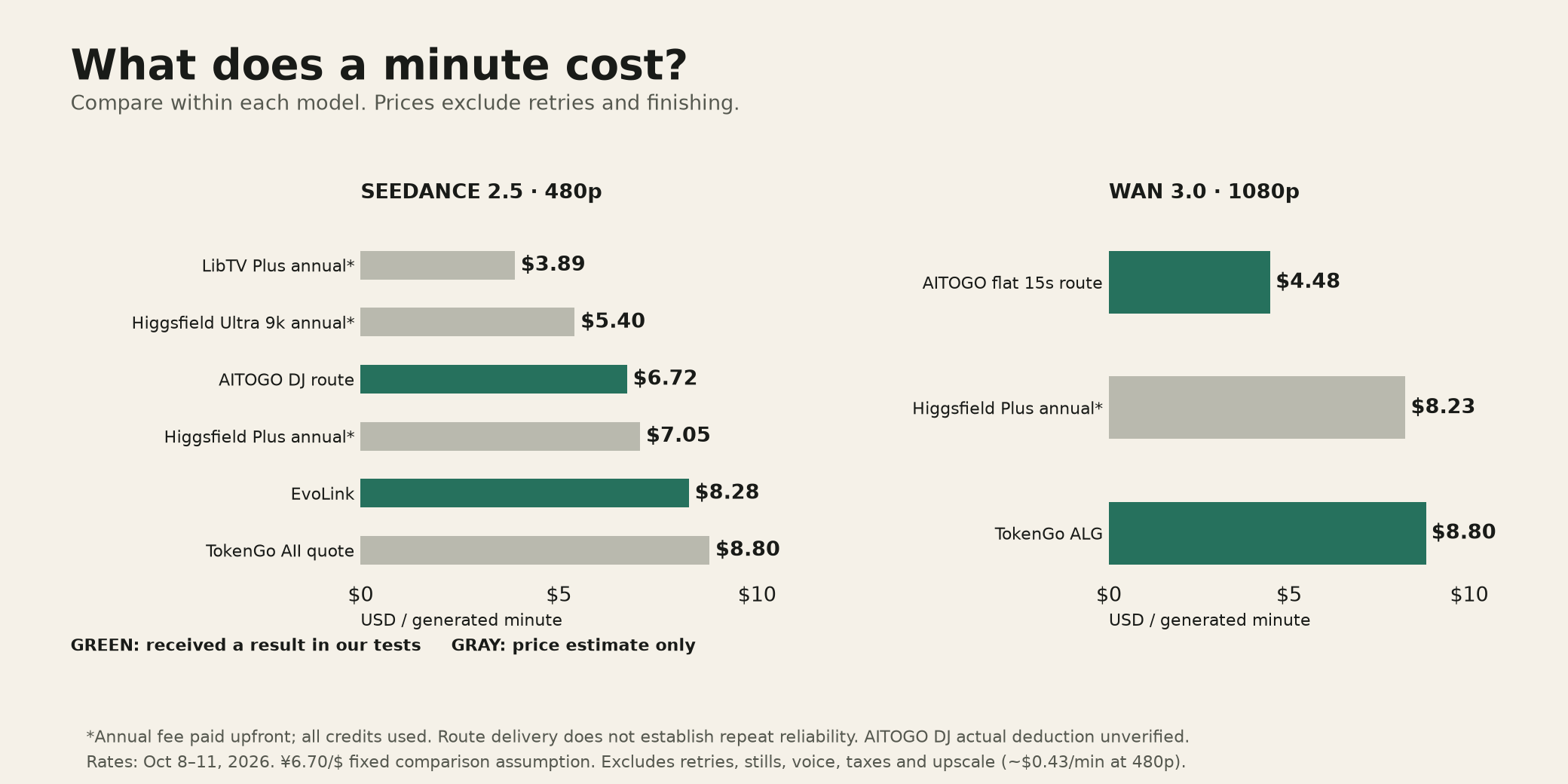
Here is how the options compare. A generated minute is not necessarily a minute you will publish. These prices exclude retries, voice creation and editing.
Why Wan is a real alternative.
Seedance is my first pick for recasting a scene. Wan earns its place when the character needs to talk.
In our tests, Wan kept the voice track we supplied. That means the same voice, words and pauses we had already approved. Seedance can recreate that speech, which gives us more to check.
Wan also gave us native 1080p we liked, without enlarging a smaller video. Our tested routes worked out to about $4.48–$8.80 per minute, depending on the supplier. For regular talking videos, voice consistency and usable picture quality are a strong combination.
The tradeoff: Wan sometimes missed an acting cue or changed the wrong background person. We still prefer Seedance for the complicated replacements shown above. Choose based on the job, not the fan club.
EvoLink: our familiar Seedance fallback.
About $8.28 per minute at 480p. Enlarging that footage to 1080p with WaveSpeed brings it to about $8.71.
It has worked in our production workflow, and the pricing is clearly listed.
The catch: enlarged 480p is still enlarged 480p. Seedance can also recreate the supplied speech rather than keep the original voice track exactly. Check the words and delivery.
LibTV: cheap if you use the allowance.
About $3.89 per minute at 480p, if you use every monthly point on the first-year annual offer.
The plan costs ¥1,199 upfront, with ¥1,799 renewal, and includes 4,600 points each month.
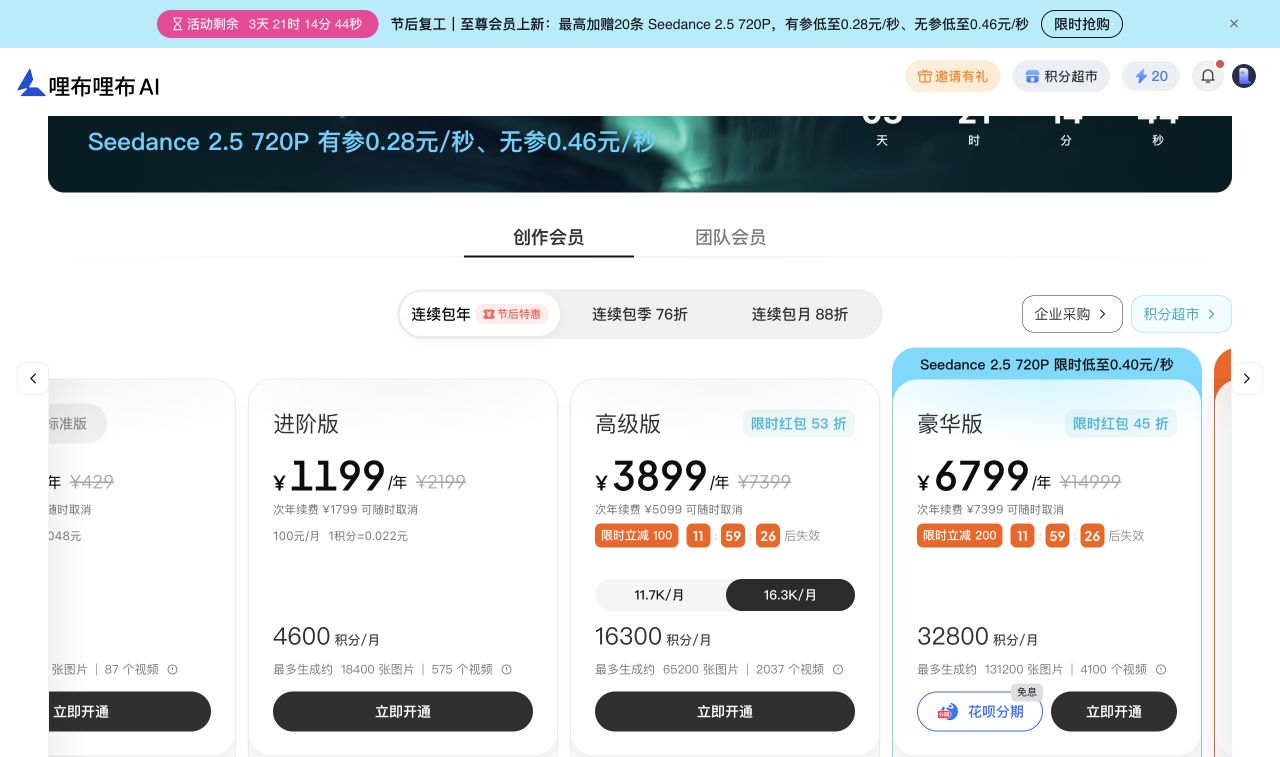
The catch: points reset after 31 days. Use half and each minute effectively costs twice as much.
Our small automation test worked. We have not verified the full paid workflow with our character references. This is promising pricing, not yet our production recommendation.
AITOGO: cheap, with some patience required.
Seedance 2.5 at about $6.72 per minute at 480p, or $7.15 after enlarging it to 1080p.
Our test accepted the supplied audio and got every word right. It took about 13 minutes. The price is the listed rate; we still need to confirm the account deduction.
AITOGO also delivered a native-1080p Wan test at a rate equivalent to $4.48 per minute. We liked the picture, though it missed one acting instruction.
The catch: other entries were paused or rejected audio. A cheap model name in a catalog does not guarantee a working service. We need more runs to judge reliability.
Token6688 / TokenGo: the settings matter.
Our current choice for talking-character videos is Wan through TokenGo's ALG channel, at about $8.80 per minute in native 1080p.
It kept our supplied audio, and we liked the hair detail and framing.
A cheaper channel, HN1K, also advertised “1080p.” Its results had harsher hair and smeared skin. One delivered file was only 720p.

Same model name. Different result. That is why the next section matters.
The others we tried.
- MiniMax and Seedance 2.0: cheaper, but we preferred Seedance 2.5's realism for our characters.
- HeyGen: the performance we tested had repetitive hand movements and weak comic timing.
- OmniHuman 1.5: acting and lip-sync problems kept it out of our workflow.
- Grok through TokenGo: very cheap, but the routes we checked generated their own speech instead of accepting our audio. The delivered test still awaits playback approval.
Those are judgments from our tests, not a ranking of everything these tools can do. Test notes.
Same Seedance 2.5. Different face, audio and video rules.
Now that we have met the providers, here is the catch: the same Seedance 2.5 model can come with different input restrictions. A cheap generation is no bargain if it refuses your character’s face, your voice recording or the video you want it to follow.
| Seedance 2.5 service | Face references | Upload your own audio? | Use a reference video? |
|---|---|---|---|
| Higgsfield | Supported. Face references are part of its reference workflow. | Yes. Image, video and audio references are available. | Yes. The API accepts video references; input duration is billable. |
| EvoLink | Supported. Our realistic AI characters passed. | Yes. Supplied speech works in reference-to-video mode. | Yes. Video references have separate input-plus-output billing. |
| LibTV | Compliance checks apply to face and other reference material. | Yes. Up to 10 audio references in its model settings. | Yes. Up to 10 video references in mixed-reference mode. |
| AITOGO · DJ 480p | Supported. Our realistic AI character passed. | Yes. Our supplied speech was accepted. | Route-specific. The shared API lists video inputs; DJ-specific support is not documented in our sources. |
| AITOGO · VID flat-rate option | Built-in face processing. | No on the tested route. It rejected our audio reference. | Route-specific. The shared API does not establish support for this exact option. |
| TokenGo · standard option | Image references supported. Face-specific limits are not stated in the checked documentation. | Yes. Select a channel that supports audio references. | Yes. Reference-video seconds count toward the bill. |
| TokenGo · per-item option | Image references supported. Face-specific limits are not stated in the checked documentation. | Depends on the channel. HV30 does not accept audio; H287 supports it at 720p / 30s in the checked listing. | No. This option has no video-reference input. |
AITOGO has face-restricted options too. Its catalog flags seedance2.5-9图 and seedance2.5-kl for face restrictions. Those are different options from DJ. The suffix matters.
Want it to follow a boxing clip, dance or camera move? Check video inputs first. Image references help define the character. A video reference supplies motion and timing. “Reference-to-video” does not guarantee that every provider option accepts all three: images, audio and video. TokenGo’s cheap per-item option, for example, has no video input.
A lower per-second rate can still produce a bigger bill. Higgsfield’s API counts both reference-video and generated-video duration; images and audio do not count as video input. EvoLink also bills reference-video jobs differently: a 10-second reference and a 10-second output count as 20 billable seconds in that example. Check the whole request, not just the headline rate. Higgsfield billing · EvoLink billing.
About Higgsfield’s advertised $0.0738/second: its blog calls this a starting rate. It does not establish that our face, audio and video-reference setup qualifies at that price; the detailed model page shows configuration-dependent pricing. Official API overview.
Audio support does not mean your recording stays untouched. In our Seedance 2.5 workflows, the model recreates the supplied speech. Check the voice, words and timing. That is one reason we use Wan when keeping the approved voice track matters.
Provider documentation and our generation records, checked October 8–12. Face-reference support does not mean every real person’s photo is accepted. Sources and exact options.
05 / Congratulations. You are now tech support.
AITOGO and TokenGo can save you money. They also give you more things to manage.
A channel is the supplier a reseller sends your request to. Different channels can have different prices, quality, supported inputs and availability.
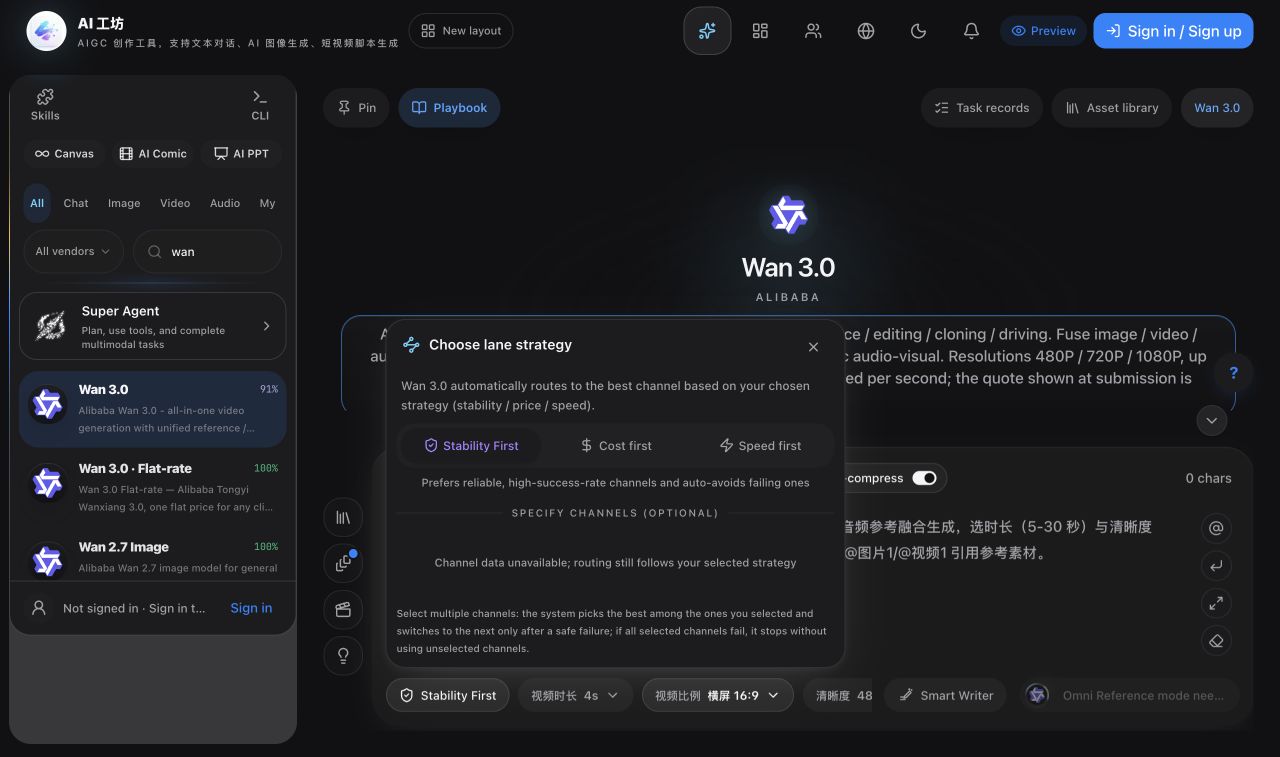
You may need to set up access keys, upload files, pick the right model and channel, wait for jobs, recover failures and check the charges.
In our TokenGo setup, the price preview can even use a different channel from the one assigned to the job. We check what actually ran.
My rule: test one short clip before sending a whole episode. Check the result and the bill. Keep a backup service ready.
These are useful tools for someone comfortable with a little technical work. If you want “click button, get video, go outside,” a simpler subscription may be worth the extra money.
06 / The clip you throw away still costs money.
Remember the 100 seconds on Higgsfield Plus at Seedance 1080p?
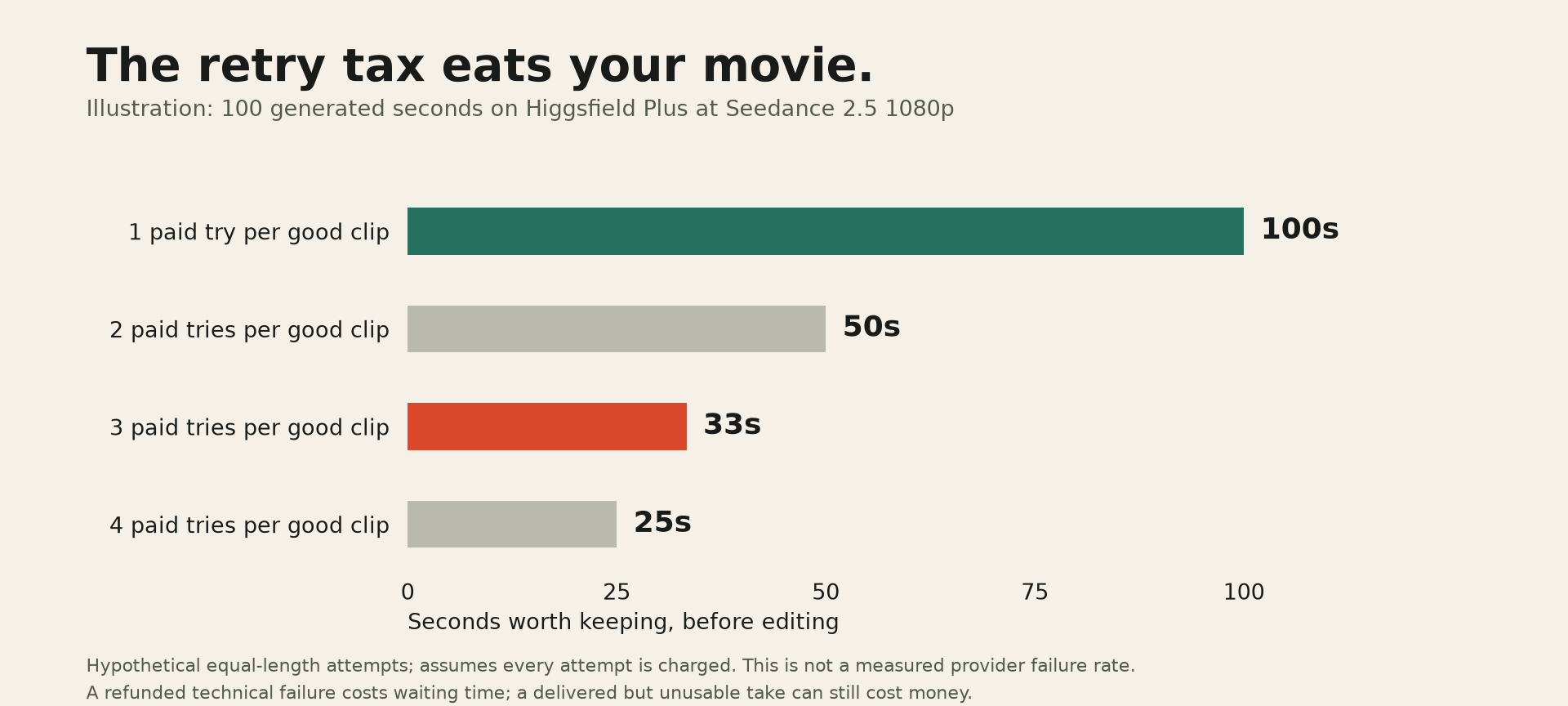
If it takes three paid attempts to get each usable clip, you have about 33 seconds worth keeping. Then you still need to edit.
That is why I track what I spent for each finished minute.
Include rejected takes, unused subscription credits, images, voice and finishing. Waiting matters too. A bargain that misses your deadline has a special talent for becoming expensive.
The cheapest plan on paper is only cheap if you use it.
A simple example: $59 on Higgsfield Plus buys 100 generated seconds of Seedance at 1080p. If every clip works first time, you can keep all 100 seconds. If each usable clip takes three paid tries, you keep about 33 seconds. This is an example, not a measured failure rate.
07 / What I would actually use.
- Easy starting point: Higgsfield. Pick a model, check how many seconds the plan buys, then read the unlimited terms.
- Character replacements like the Luc clips: Seedance 2.5. Start with one short test of your hardest movement.
- Our talking-character videos: Wan through TokenGo's ALG channel. It keeps our voice track and gives us native 1080p we like.
- Cheaper Seedance with supplied audio: AITOGO's tested 480p option. EvoLink is our established fallback.
- Worth watching: LibTV's subscription math and AITOGO's cheaper Wan option. Both need more testing for our workflow.
Jean Phil's views are inspiration. They are not included with your subscription.
The viral clip makes you subscribe. The usable seconds tell you whether to renew.
Prices checked October 8–11, 2026. Screenshots captured October 11. Account statistics are from October 1. Full calculations, test records and limitations are in the source notes.
Comments
What have you tried? Share your results, questions, or a price we should check.
Loading comments…